Hyperhidrosis
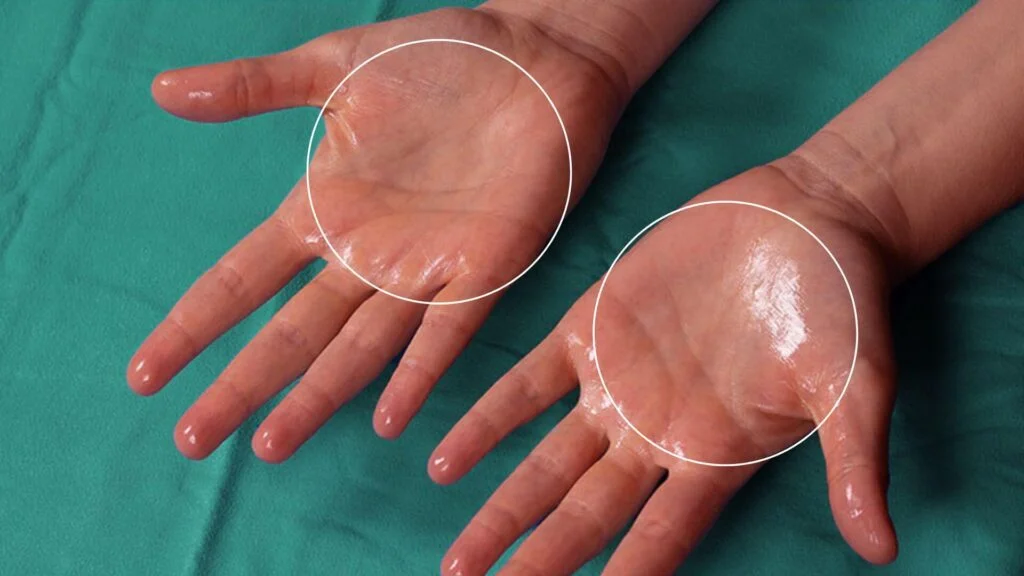
Hyperhidrosis is excessive sweating beyond what the body needs for normal temperature regulation. It can affect the palms, underarms or feet and may begin during childhood or adolescence. Severe cases can interfere with school, writing, daily activities and social interaction. Treatment usually begins with non-surgical options, while surgery is reserved for carefully selected severe cases that have not responded adequately to appropriate conservative treatment.
Overview
Sweating is a normal body function that helps regulate temperature.
With hyperhidrosis, sweat production is greater than necessary and may occur even when the environment is not hot and the child is not exercising.
There are two broad categories:
- Primary focal hyperhidrosis, which affects particular areas such as the palms, axillae or soles without another medical condition explaining the sweating.
- Secondary hyperhidrosis, in which excessive sweating is caused by an underlying condition, medication or another identifiable factor.
Primary focal hyperhidrosis commonly begins during childhood or adolescence.
Although it may appear to be a minor problem, severe sweating can significantly interfere with writing, device use, handling objects, sport and social activities.
Palms, underarms and soles
Based on symptoms after considering secondary causes
Usually begins with non-surgical options
Reserved for selected severe cases after conservative treatment
What is Hyperhidrosis?
Hyperhidrosis means excessive sweating beyond what is required for normal cooling of the body.
Primary focal hyperhidrosis usually affects specific body regions.
Common sites include:
- Palms.
- Soles.
- Axillae.
More than one area may be affected in the same child.
Sweating is often relatively symmetrical and may become worse with stress or warm conditions, although it can also occur without an obvious trigger.
In primary focal hyperhidrosis, excessive sweating generally decreases significantly during sleep.
Sweating affecting most of the body, starting suddenly or occurring prominently during sleep may lead the clinician to investigate a secondary cause.
How Can it Affect a Child?
Hyperhidrosis does not cause the same degree of difficulty for every child.
Mild disease may be a manageable inconvenience.
Severe palmar sweating, however, can cause:
- Wet school papers.
- Difficulty holding a pen or pencil.
- Difficulty using touchscreens.
- Objects or sports equipment slipping from the hands.
- Difficulty with fine motor tasks.
- Avoidance of handshakes or holding hands.
- Embarrassment and social anxiety.
Severe plantar sweating may create persistent moisture inside shoes and contribute to skin irritation.
Axillary sweating may repeatedly soak through clothing.
The effect on everyday life is an important part of assessing disease severity and deciding how aggressively it should be treated.
Primary and Secondary Hyperhidrosis
Before diagnosing primary hyperhidrosis, the possibility of another cause should be considered.
Primary focal hyperhidrosis commonly:
- Begins relatively early in life.
- Affects specific areas.
- Is approximately symmetrical.
- Occurs mainly while awake.
- Decreases significantly during sleep.
- May occur in other family members.
Secondary hyperhidrosis:
Can result from a medical condition, medication or another physiological problem.
Sweating may be more generalized or may begin suddenly after previously normal sweating.
Depending on the child's symptoms, possible causes the clinician may consider include:
- Thyroid disorders.
- Hypoglycemia in selected circumstances.
- Certain infections or systemic illnesses.
- Some neurological conditions.
- Medications.
- Other medical conditions suggested by the child's history.
Not every child requires extensive laboratory testing.
Investigations are selected when the history or examination suggests a possible secondary cause.
Diagnosis
Assessment begins with understanding the pattern of sweating and its effect on the child's daily life.
The clinician may ask about:
- The age symptoms began.
- Which body areas are affected.
- Whether sweating is symmetrical.
- Whether it occurs during sleep.
- Its effect on school, sport and daily activities.
- Other symptoms such as weight loss, palpitations, fever or fatigue.
- Current medications.
- Family history of similar excessive sweating.
A physical examination is then performed.
When symptoms are typical of primary focal hyperhidrosis and there are no signs suggesting another illness, special imaging or diagnostic tests are usually not required.
If features are unusual, laboratory testing or additional assessment may be used to look for a secondary cause.
Non-Surgical Treatment
Treatment usually begins with non-surgical approaches.
The choice depends on:
- The affected area.
- Severity.
- The child's age.
- Impact on daily life.
- Treatments already attempted.
Medical Antiperspirants:
Products containing aluminum salts can reduce sweat production by blocking sweat ducts.
They are commonly used as an initial treatment.
Skin irritation can occur, so appropriate application instructions should be followed.
Iontophoresis:
Iontophoresis uses a low electrical current passed through water to reduce sweating.
It is particularly useful for palmar and plantar hyperhidrosis.
Repeated treatments are generally needed initially, followed by maintenance sessions when effective.
Medication:
Anticholinergic medications may be used in selected patients to reduce stimulation of sweat glands.
Possible adverse effects can include:
- Dry mouth.
- Constipation.
- Blurred vision.
- Difficulty urinating.
- Other medication-specific effects.
These medicines should therefore be used under medical supervision.
Botulinum Toxin:
Botulinum toxin injections can temporarily reduce nerve stimulation of sweat glands in selected areas.
The effect is temporary and repeat treatment may be required.
Injections can also be uncomfortable, particularly when treating the palms or soles.
No single treatment is appropriate for every child, so management is individualized.
When is Surgery Considered?
Surgery is not first-line treatment for hyperhidrosis.
It is considered only when a child has severe primary hyperhidrosis that significantly affects daily life and appropriate non-surgical treatments have failed to provide adequate control.
The surgical procedure is called Endoscopic Thoracic Sympathectomy or Thoracoscopic Sympathectomy, commonly abbreviated as ETS.
It is used particularly for carefully selected patients with severe palmar hyperhidrosis.
During the procedure, the surgeon uses a minimally invasive thoracoscopic approach to reach part of the sympathetic nerve chain inside the chest.
The nerve signals responsible for excessive sweating in the targeted region are interrupted.
The procedure can substantially reduce palmar sweating, but candidacy should not be based on sweating severity alone.
Assessment also considers:
- Impact on daily life.
- The child's age and maturity.
- Previous non-surgical treatments.
- Expectations of the child and family.
- Understanding of potential complications.
The Key Surgical Issue: Compensatory Sweating
The most important potential consequence to discuss before sympathectomy is compensatory sweating.
After sweating is reduced in the targeted region, increased sweating may develop elsewhere on the body.
Possible areas include:
- Back.
- Abdomen.
- Chest.
- Legs.
- Other body regions.
The severity varies considerably between patients.
It may be mild and acceptable, or it may become significantly troublesome.
There is no way to guarantee before surgery that compensatory sweating will not occur.
Children and families should therefore understand that treating severe sweating in one region creates the possibility of increased sweating elsewhere.
This is one of the main reasons surgery is reserved for carefully selected patients after non-surgical treatment has been explored.
Other Surgical Risks
Like any thoracoscopic operation, sympathectomy has potential complications.
These may include:
- Postoperative pain.
- Bleeding.
- Air collecting around the lung, or pneumothorax.
- Anesthesia-related complications.
- Compensatory sweating.
- Excessive dryness of the hands.
- Less improvement than expected.
- Recurrence of sweating.
- Unintended injury to nearby nerves or tissues.
- Horner syndrome in rare circumstances if certain upper sympathetic nerves are affected.
The likelihood of individual complications varies with the operative level, technique and individual patient.
Potential benefits and risks should be discussed clearly before surgery is selected.
Before Surgery
Before surgical treatment is considered, the team confirms that the child has primary hyperhidrosis suitable for surgery rather than excessive sweating caused by another medical condition.
Assessment reviews:
- When symptoms began.
- Areas involved.
- Severity of sweating.
- Effect on school, social life and activities.
- Non-surgical treatments already attempted.
- Current medications.
- Associated medical conditions.
Additional tests may be requested when there are features suggesting secondary hyperhidrosis.
Before surgery, the child and family should understand:
- The goal of surgery.
- Which areas are expected to become drier.
- That outcomes cannot be identical for every patient.
- The possibility of compensatory sweating.
- The possibility of persistent or recurrent sweating.
- Other surgical risks.
- Non-surgical alternatives.
Fasting and medication instructions before anesthesia should be followed, and the medical team should be informed if the child develops fever, infection or another new illness before surgery.
After Surgery and Follow-up
After thoracoscopic sympathectomy, the child is monitored to ensure stable breathing and circulation and adequate pain control.
Some discomfort at the small thoracoscopic incisions or inside the chest may occur during early recovery.
The surgical team determines when the child can return to:
- School.
- Normal daily activities.
- Sports.
- Normal bathing.
Parents should follow instructions regarding wound care, medication and activity.
The medical team should be contacted if the child develops:
- Difficulty breathing.
- Severe or increasing chest pain.
- Significant fever.
- Increasing redness, swelling or drainage from the incisions.
- Clear deterioration in general condition.
- Any sudden symptom that causes concern.
Follow-up assesses:
- Reduction of sweating in the targeted area.
- Excessive dryness.
- Development and severity of compensatory sweating.
- Effect of treatment on everyday activities.
- Any new symptoms.
Treatment success should be considered from the child's perspective and quality of life, not simply by measuring the amount of sweat.
Frequently Asked Questions
Does every child who sweats a lot have hyperhidrosis?
No. Sweating normally increases with heat, exercise and emotion. Hyperhidrosis refers to excessive recurrent sweating beyond what is expected and significant enough to affect daily life. Other medical causes may also need to be considered.
Which areas are commonly affected by primary hyperhidrosis?
The palms, soles and underarms are among the most common areas, and more than one region may be affected in the same child.
Does my child need blood tests to diagnose hyperhidrosis?
Not always. Typical primary focal hyperhidrosis is usually diagnosed from the history and examination. Testing is used when symptoms suggest a possible secondary medical cause.
Are there treatments before surgery?
Yes. Options include medical antiperspirants, iontophoresis, selected oral medications and botulinum toxin injections. Surgery is considered only after appropriate non-surgical options have been evaluated.
What is ETS?
Endoscopic thoracic sympathectomy is a minimally invasive chest operation that interrupts part of the sympathetic nerve signals responsible for excessive sweating. It is used particularly in carefully selected patients with severe palmar hyperhidrosis.
What is compensatory sweating?
Compensatory sweating is increased sweating in other parts of the body after sympathectomy. It can range from mild to severe, and it cannot be guaranteed that it will not occur.
Is hyperhidrosis surgery appropriate for every child?
No. Surgery is reserved for carefully selected patients with severe primary hyperhidrosis that significantly affects everyday life and has not responded adequately to appropriate non-surgical treatment.
Can sweating return after surgery?
Some sweating can persist or recur in the treated region. Increased sweating may also develop elsewhere on the body, so expectations and risks should be discussed carefully before surgery.
Book Your Consultation
If your child has severe sweating of the palms, underarms or feet that interferes with school or everyday activities, you can book a consultation to assess the type of hyperhidrosis, review treatment options and determine whether surgical assessment is appropriate.
Video Presentation
Video presentation coming soon